
Nikro Air Duct Cleaning in Hamilton Lakes: A Homeowner’s Guide
Owning a Nikro machine and using one well are two different things. Plenty of contractors list Nikro or “HEPA vacuum” on their website and still leave a home’s duct system half-cleaned because they never set negative pressure correctly for the volume of ductwork in front of them. A Nikro unit pulls a specific column of air, and if it’s undersized or the registers aren’t sealed during suction, that pull leaks out into the room instead of through the ducts. This guide explains what a Nikro machine actually does so you can judge whether the person running it knows what they’re doing.
If you’d rather not sort that out yourself, call (877) 792-7445 and we’ll walk you through it.
What does a Nikro machine actually do during a duct clean?
A Nikro air duct cleaning setup works by creating a controlled pressure differential between your duct system and the room around it. The vacuum pulls air through the ducts toward the machine’s intake, so any debris that gets dislodged travels in one direction, into the captured air stream, instead of drifting into the living space. That’s the whole point. It’s not suction for its own sake; it’s containment.
Here’s the sequence that matters:
- The vacuum is connected to the main trunk or plenum so the machine draws from the largest air volume in the system.
- Registers and returns are sealed off or opened one at a time, so the machine’s pull stays concentrated on the section being worked and doesn’t get diluted by open room air.
- Debris travels one way, toward the HEPA filter and collection point, not back out through a nearby supply vent.
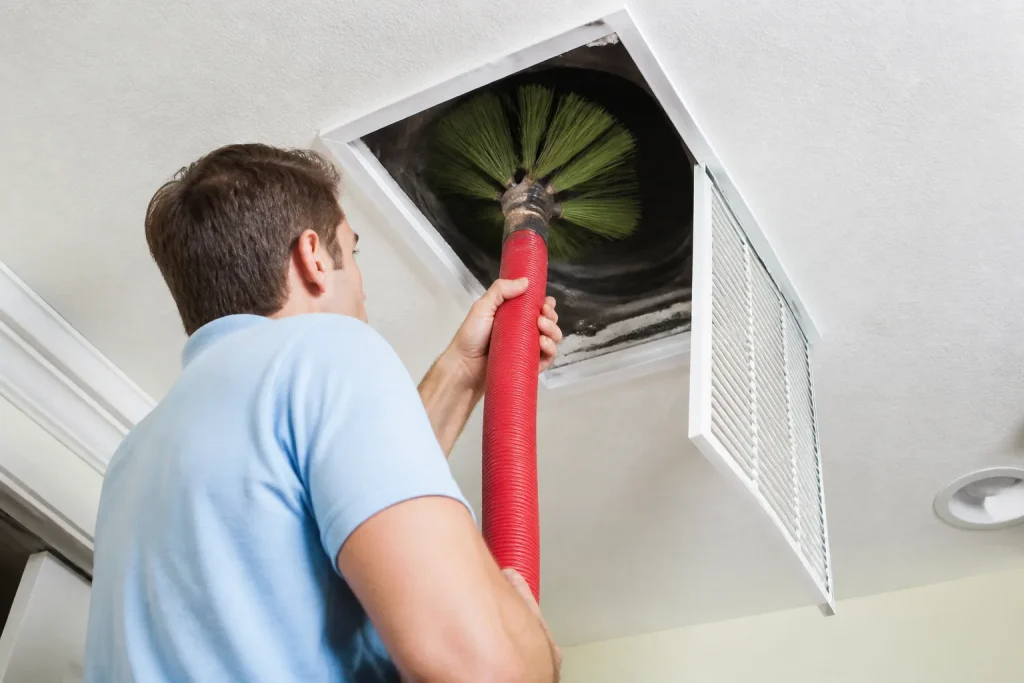
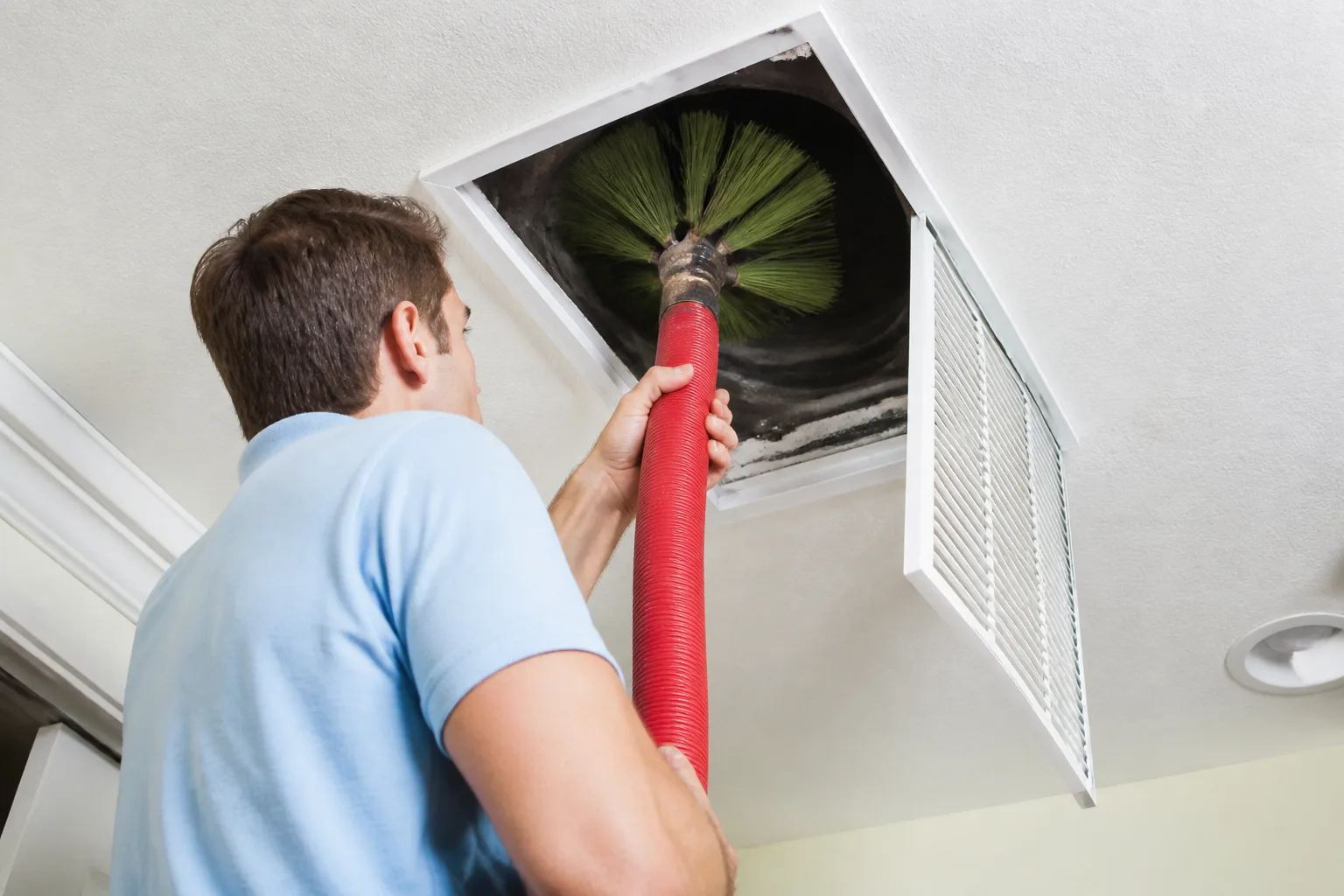
- Agitation tools loosen what’s stuck to the duct walls, and the vacuum carries it away.
When we talk about a typical Hamilton Lakes home in the 1,800 – 2,400 sq ft range with a standard trunk-and-branch layout, the duct volume is modest but not trivial. A machine with a low CFM rating can struggle to maintain meaningful negative pressure across a long trunk run plus several branches at once. That’s why matching the CFM to the job, and working the system zone by zone rather than blasting one giant suction across every open register, is the difference between a real clean and a surface pass.
If you want to see the broader scope of what a full clean involves, our air duct cleaning page lays out the whole process from intake to return.
Why CFM ratings matter for a Hamilton Lakes home
CFM stands for cubic feet per minute, and it’s the honest measure of how much air a vacuum can actually move. A shop vac might be rated at a high peak number but can’t sustain it through a long duct run. A Nikro machine, rated for professional use with HEPA filtration in the exhaust stream, is sized to keep pulling volume even through elevated static pressure from filters, bends and long branches.
What does that mean for your house in Hamilton Lakes? Standard homes here run a central system with a single return, a main trunk, and branches feeding individual rooms. The resistance in that system isn’t constant; it changes as you open registers, block others, and move to a different branch. A properly sized Nikro machine can hold meaningful suction against that shifting load. An undersized or improperly configured setup can’t, and the technician compensates by slowing down or by not sealing registers at all, which lets the suction escape into the room via the nearest open return.
Some practical things to ask or notice:
- Does the technician talk about sizing the vacuum to your system, or just turn it on?
- Are registers being worked one at a time while the others stay sealed?
- Is the machine connected at the plenum or main trunk, or is it running with an open bypass?
When we’re sizing a job in Hamilton Lakes, the answer depends on total duct length, the number of branches and returns, and how tight the system is. Our technicians have up to 11 years of experience, and most of that judgment is about reading the system, not just running the machine.
Why Nikro alone isn’t enough: agitation is the other half
A vacuum creates removal capacity. It does not, by itself, dislodge debris. Dust, dander, construction residue and lint are adhered to the duct walls, especially near the plenum and along the inside of elbows. Suction without agitation removes the loose material and leaves the stuck-on layer.
That’s why a professional clean pairs a Nikro or comparable HEPA vacuum with agitation tools, typically a Rotobrush rotary brush system for trunks and rigid duct, and pneumatic whips or similar tools for the harder-to-reach branches. The agitation scrubs the walls; the vacuum carries away what the brush loosens. Running one without the other is the single most common failure we see in the trade. A contractor who owns a Nikro unit but doesn’t use Rotary agitation has a very expensive way of blowing air through your ducts and calling it cleaning.
This pairing matters even more in homes that have had recent renovation work or a long gap since the last clean. Drywall dust and fine construction debris settle into duct seams and slow recirculation, and it takes both mechanical contact and strong suction to move it.
What does HEPA filtration capture, and why does it matter?
HEPA filtration in a Nikro exhaust stream is what keeps the debris you pull out from becoming the debris you put back. Without a proper filter on the exhaust, the machine acts as a blower: it pulls dust and allergens out of the duct and pushes them into the room air through the exhaust. That’s the opposite of what you paid for.
A HEPA-rated filter captures fine particulate at a high efficiency level, which matters for households with respiratory sensitivity, asthma, or allergy symptoms that worsen in the house. It also matters right after a renovation or a home purchase, when unknown duct history makes extra caution worthwhile. And it matters for containment on a general level: the goal is that the debris captured from Hamilton Lakes duct systems ends up in the collection bag, not on your living room furniture.
When a job needs a higher degree of containment, we also work with Abatement Technologies negative-air equipment in the same visit. Abatement machines are built for remediation work where the air in the work zone must be kept separated from the rest of the home. Pairing that with the Nikro HEPA vacuum in the exhaust stream gives a level of cross-contamination control that portable vacuums simply can’t reach.
If dryer vents are part of the concern, that’s a separate concern with its own safety layer; dryer vent cleaning handles the lint and heat issue that builds up independently of the HVAC duct system.
Red flags that a technician is under-performing with professional equipment
Owning the right machine is table stakes. Using it correctly is what you’re actually paying for. Here are the tell-tale signs a technician has the Nikro unit out but isn’t running a real clean:
- Registers are left open during suction. If every supply and return is open while the vacuum runs, the pull is diluted and the duct system mostly just recirculates. A proper clean works zone by zone with the others closed off or held closed with the seal.
- No post-clean pressure check. A technician who never checks static pressure or airflow after the clean has no way of knowing whether the ducts were actually opened up or partly obstructed. A pressure check isn’t exotic; it takes a few minutes and a manometer and tells you whether the work landed.
- The plenum is skipped. The plenum, the large box where the duct meets the furnace or air handler, is often where the most debris collects. If the plenum and main trunk aren’t addressed, the clean isn’t done.
- Agitation is missing. No rotary brush, no whips, just suction. This is a sign the crew is treating the machine as a vacuum up loose dust, not as one half of a mechanical clean.
- No pre-clean photos or scope agreement. You can’t evaluate a clean you never saw the start of. Photos before and after are basic accountability.
- The machine’s exhaust filter is missing or bypassed. A Nikro without the HEPA filter in place is just an expensive shop vac that’s pulling dust out of the duct and into your hallway.
If you notice any of these while a technician is working in your Hamilton Lakes home, ask the question. A crew that knows the equipment will explain its own setup without flinching. One that doesn’t will change the topic.
When to call a pro instead of doing it yourself
This isn’t a job for a rented unit from a hardware store. The supply-air outlets in a duct system can carry the full volume of the air handler’s exhaust, and pulling that volume with the wrong equipment or the wrong seal can send dust out through return registers into the room. The plenum and main trunk are where the most debris lives, and those are the harder, tighter spaces to reach without professional tools. There’s also the practical matter of the air handler itself: opening or disturbing the blower or coil while cleaning ductwork isn’t a homeowner project, and it needs to be handled carefully.
The airflow side of the system is worth respecting. Even a well-intentioned DIY attempt with a shop vac and a hose will stir up more than it captures, and in a home where anyone has asthma or sensitivities, that’s the wrong trade. A proper duct clean in Hamilton Lakes is a mechanical job with three distinct parts: containment, agitation and verification. Skip any of them and you’ll have the same ducts with more dust in the air than when you started.
The full HVAC components, coil and blower assembly are part of the picture too. Our HVAC cleaning covers the equipment side of the system, not just the ducts feeding into it.
Related services in Hamilton Lakes
Nikro air duct cleaning pairs naturally with the other parts of the indoor air quality ecosystem. Duct Repair & Sealing catches leaks and disconnected joints found during a clean, and the Air Quality & Sanitizing service addresses biological contaminants after the mechanical work is done. Familiarity with Honeywell and Aprilaire filtration and humidity control helps when the next step you’re considering is a filter or dehumidifier upgrade, and Guardsman sanitizing treatments handle what mechanical cleaning can’t reach.
The Bottom Line
A Nikro machine is a serious piece of equipment, and when it’s properly sized with CFM matched to your duct volume, connected at the plenum, sealed register by register, and paired with agitation tools, the result is a genuinely cleaner duct system and a real reduction in airborne debris. When it’s misused, it’s a lot of noise and almost no removal. The equipment matters. The technician’s understanding of it matters more.
Three things worth remembering when you’re evaluating a quote in Hamilton Lakes:
- A HEPA-rated Nikro vacuum with Abatement Technologies negative-air equipment is a containment system, not just suction.
- Agitation (Rotobrush, whips) plus suction equals removal. Either one alone doesn’t.
- Post-clean pressure checks, pre- and post-clean photos and plenum coverage are the marks of a real job.
If you want to see these tools and this process applied to your own home, our air duct cleaning Hamilton Lakes team offers free estimates. We’ll show you what we’re working with, talk through sizing for your particular system, and give you a written estimate before anything starts. One flat price per system, agreed up front, plus before-and-after photos of your own ducts.
Call (877) 792-7445. We answer 24/7. Fast dispatch from 7am to 7pm, Sunday through Friday.
Frequently Asked Questions
Nikro air duct cleaning is professional duct cleaning using Nikro HEPA-rated vacuum equipment, which is built to maintain strong negative pressure across a full residential duct system while filtering the exhaust stream so dislodged debris is captured, not redistributed. The main difference from a shop-vac approach is that HEPA-rated negative-air machines are designed to hold meaningful suction against the resistance of a real trunk-and-branch layout, with containment on the exhaust side. Nikro equipment is also typically paired with agitation tools, not used alone. Call (877) 792-7445 for an exact quote on your system.
Air duct cleaning in Hamilton Lakes typically runs $350 to $900 for a whole-home system, depending on duct length, number of branches and returns, whether the plenum is included, and how much agitation work is needed. A cleaning plus repair and sealing or sanitizing may run higher. The important point isn’t the range; it’s that a real quote is per system, not per vent, with a written estimate agreed before any work starts. Call (877) 792-7445 for a free estimate – we set the price per job by written estimate.
Ask for before-and-after photos of your own ducts, including the plenum and main trunk. Ask whether a post-clean pressure check was performed, and if it was, what the numbers were. Ask what tools were used: rotary brush, pneumatic whips, and which vacuum model. A crew that ran a real clean will answer all three without hesitation and can show the results. If photos aren’t offered, ask for them. Call (877) 792-7445 to schedule a free estimate and we’ll walk you through the scope.
Every few years is a reasonable default for most homes, but the more useful answer is that it depends on the house. A home with pets, recent renovation, allergies in the household, or an unknown duct history from a recent purchase usually needs it sooner than a low-occupancy home with regular filter changes. If you notice visible dust blowing from registers, worsening allergy symptoms, or a stuffy smell when the air handler runs, that’s a reason to have it looked at regardless of the calendar. Call (877) 792-7445 for a free estimate and a straight answer on whether it’s time.
Written by the team at Air Duct Cleaning Hamilton Lakes.
Need Air Duct Cleaning Help?
Call Air Duct Cleaning Hamilton Lakes - the local pro we connect you with is licensed and insured, here with fast help in Hamilton Lakes.
(877) 792-7445