
Top Signs You Need Air Duct Cleaning Service – Don’t Ignore These
If dust settles back onto your coffee table within two days of wiping it down, and your filter is caving in every few weeks, the problem is usually not your cleaning habits. It’s the ductwork feeding the room. Those are behavioral signals: your blower is pushing stored debris back into living space every time it runs. Here’s how to read them before they turn into an air quality issue. If you’d rather not crawl around the attic yourself, call (877) 792-7445.
Why Ducts Cause Symptoms You Can’t See
Most homeowners assume dirty ducts announce themselves with visible dust plumes at the register. They don’t. The reliable signals are patterns in how your HVAC system behaves and how the indoor environment feels, and those patterns are easy to misread as equipment problems.
A standard supply run in a Hamilton Lakes home carries a few hundred cubic feet per minute. Every time the blower kicks on, that airflow passes over whatever has collected on the interior walls of the duct. If the accumulation is significant, the air entering your living room is carrying fine particulate along with it. The register grille stays clean. The ceiling stays clean. But horizontal surfaces in the same room pick up new layers within a day or two.
We’ve found this is the single most common reason a homeowner calls about “dusty house” when nothing in the house has actually changed. The HVAC equipment reads fine on a service report. The filter changes at the right interval. The ducts are the variable nobody has looked at.
What follows are the specific signals worth acting on, in the order we typically see them show up.
Sign 1: Your Filter Loads Up in Under Three Weeks
Filter loading rate is the most quantitative signal you have. A standard 1-inch MERV-8 filter in a typical Hamilton Lakes home should last roughly 60 to 90 days before it looks meaningfully loaded. If yours is visibly gray and matted inside three weeks, the filter is doing its job against something it wasn’t designed to catch at that volume.
Ambient household dust doesn’t produce that kind of loading. Internal duct contamination does. Here’s the distinction:
- Normal ambient dust loading: gradual color change, even distribution, filter still passes air easily at its rated interval.
- Duct-driven loading: rapid darkening, heavy matting on the return-side face, filter visibly bowed from airflow restriction within two or three weeks.
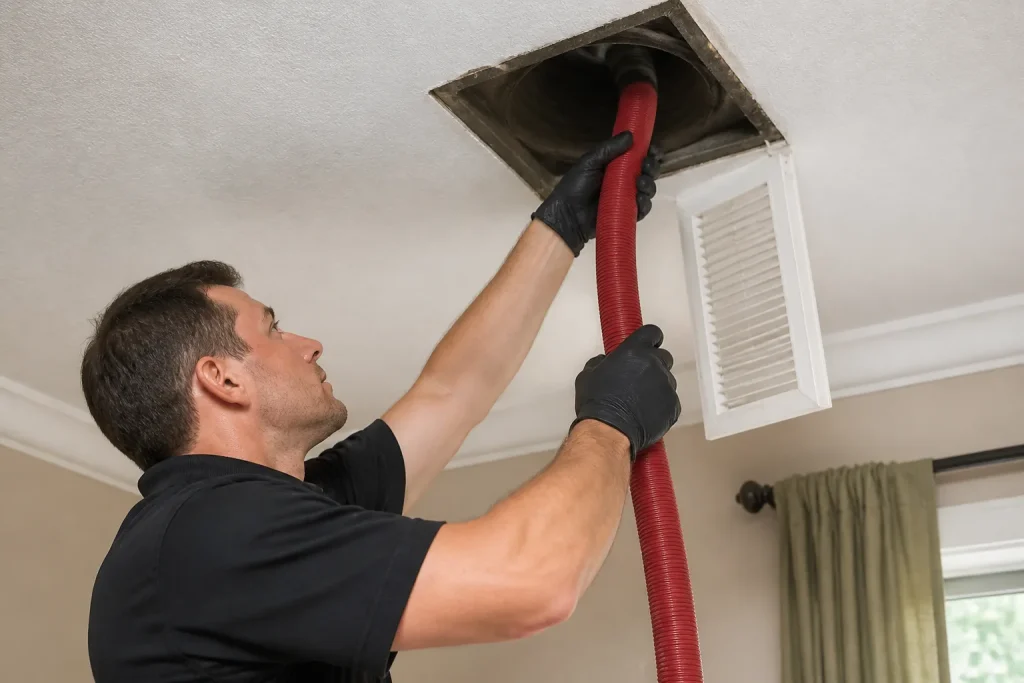
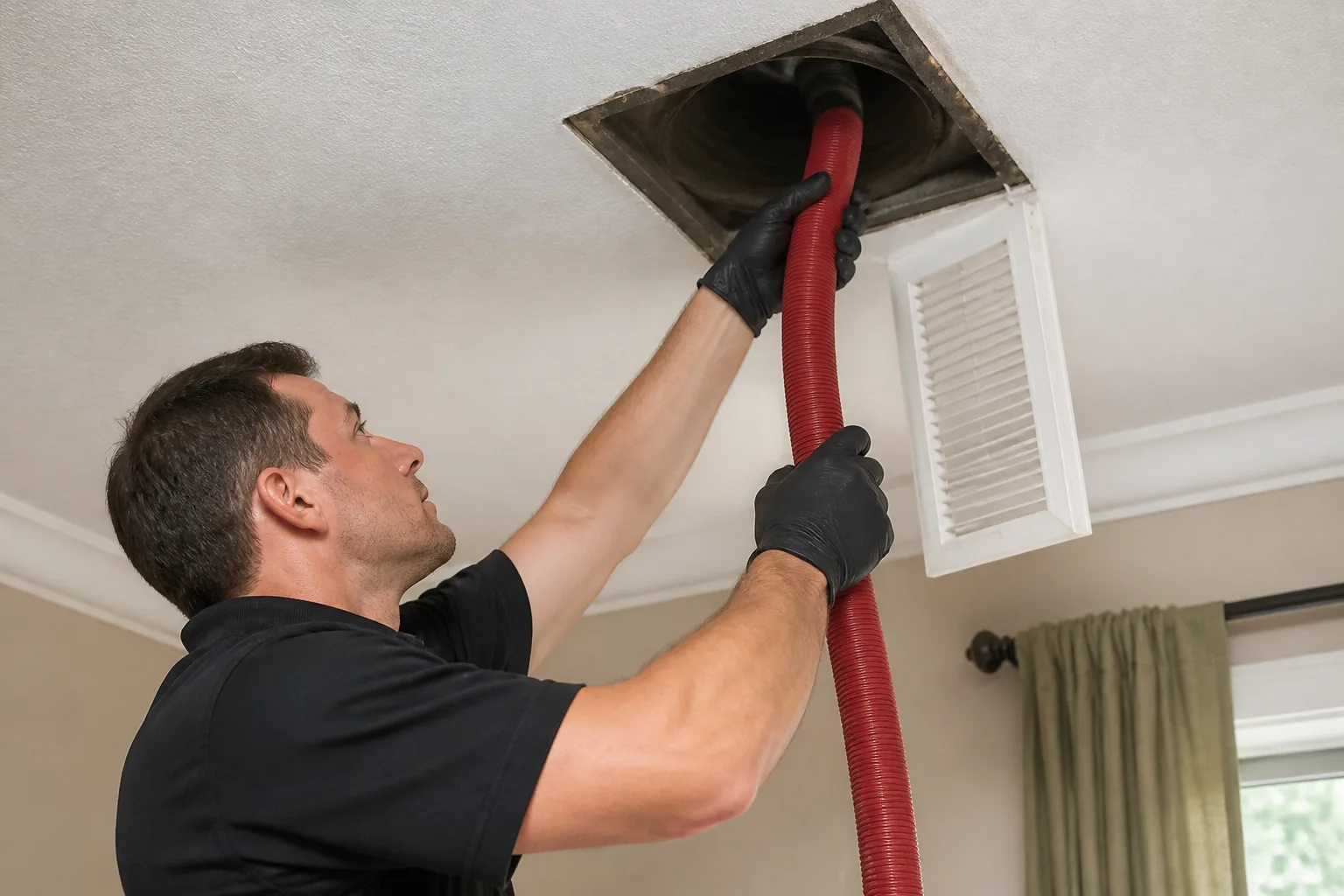
When we see that pattern during an air duct cleaning visit in Hamilton Lakes, the inside of the return trunk usually tells the story immediately. A Rotobrush rotary brush run through the return line brings out enough material to fill a bag before we’ve reached the supply side.
If you’ve bumped filter MERV rating to compensate and the loading hasn’t slowed, that’s another indicator pointing inward rather than outward. Higher filtration catches more but doesn’t remove the source.
Sign 2: An Odor That Follows the Blower, Not the Calendar
Odor is where duct problems get specific. The timing and quality of the smell tells you what kind of contamination you’re dealing with, and they’re distinct enough that most homeowners can identify which pattern matches by paying attention to when the smell appears.
The three odor profiles
- Biological growth: a musty, damp, basement-like smell that appears a few minutes after the blower starts and fades after it stops. Intensity builds over weeks. This is characteristic of moisture-related growth on duct surfaces, often in the return system or near cooling coils.
- Debris contamination: a dry, dusty, vaguely papery smell tied directly to the blower cycle, with no persistence between cycles. Typically heavy accumulation of settled particulate, sometimes from a renovation or a long period without cleaning.
- Dead rodent presence: a sharp, persistent odor that doesn’t track the blower as cleanly, usually strongest near one room or one return grille. It doesn’t fade when the system is off. That distinction matters for diagnosis.
Sanitizing after mechanical cleaning addresses the first category directly. We use Guardsman-brand treatments for that step because the growth has to be killed after the debris is removed, not before. Cleaning alone won’t fix a biological smell in Hamilton Lakes, and sanitizing alone without mechanical removal just coats the problem.
Sign 3: Rooms That Won’t Match Temperatures
Uneven room temperatures in a home with recently serviced HVAC equipment almost always trace to airflow restriction, not equipment capacity. That’s a strong statement, and we stand behind it. If your system is the right size for the house and it was serviced within the last year, and one or two rooms still run five degrees off the rest, the supply runs feeding those rooms are the first place to look.
Debris-restricted runs reduce airflow at the register. The thermostat reads the average of the house and calls for longer runtimes. The rooms with clear ducts overheat. The rooms with restricted ducts never catch up. The equipment gets blamed. The equipment is fine.
A few things to check before calling an HVAC contractor:
- Compare airflow at the register in the problem room to a nearby room using a tissue or a strip of toilet paper held against the grille.
- Check whether the problem room is at the far end of a long duct run. Distance compounds restriction.
- Look for kinked or disconnected flex duct in attic spaces above the problem room. Duct Repair & Sealing catches these in the same visit as cleaning.
This is why we treat repair and cleaning as one job rather than two. If we clean a run that’s also disconnected, we’ve just cleaned the wrong thing.
Sign 4: You Renovated 90 to 120 Days Ago
Post-renovation debris settlement has a timeline most homeowners miss. Drywall dust and construction particulate don’t all land in the ductwork immediately. Fine material stays suspended, moves with air currents, and settles gradually into the system over 90 to 120 days after the work is complete.
Cleaning the ducts immediately after a renovation catches the initial dump of material but misses the slow tail. Waiting a full season catches the bulk of it, which is why we usually recommend scheduling the cleaning at the three-to-four-month mark rather than the week the drywall comes down.
The signal that the timeline has run its course: filter loading rates stabilizing at a higher level than before the renovation, or dust returning to surfaces that were clean during the construction period. In Hamilton Lakes, homes with recent kitchen or bath remodels are the most common source of this pattern.
Sign 5: Symptoms That Worsen When the Blower Runs
Allergy and asthma symptoms tied to duct contamination share one signature: they get worse specifically when the HVAC blower is running, not continuously through the day. If symptoms spike in the minutes after the system kicks on and settle when it cycles off, the ductwork is the most likely culprit.
Mechanical cleaning with a Nikro HEPA-rated vacuum capture system removes the particulate that drives that pattern. Negative-air equipment from Abatement Technologies ensures the dislodged debris leaves the system rather than being redistributed into living space during the process. That’s the difference between professional equipment and a shop vac duct cleaning: capture at the source versus stirring it up.
If symptoms are seasonal and unrelated to HVAC cycling, ducts are probably not the cause. If they follow the blower, they usually are.
When to Call a Pro
If two or more of the signals above match your home, a professional inspection makes sense. Filter loading rate and odor patterns alone are worth a call. Cosmetic dust that returns within 48 hours of cleaning is worth a call. Visible debris inside a supply register is past due.
The local pro connected through Air Duct Cleaning Hamilton Lakes works with full professional-grade equipment across air duct cleaning, dryer vent cleaning, and HVAC cleaning, plus duct repair and sanitizing. One flat price per system agreed before work starts, before-and-after photos of your own ducts, and a satisfaction guarantee. The local pro is licensed and insured as North Carolina requires.
One short note on humor: if your filter looks like it’s been through a small sandstorm in three weeks, it probably has.
The Bottom Line
Duct problems rarely announce themselves at the register. They show up as rapid filter loading, blower-timed odors, temperature gaps in a serviced system, post-renovation dust that won’t quit, and symptom patterns that follow the HVAC cycle. Read those signals early and you’ll spend less on filters and more on clean air.
If you’re in Hamilton Lakes and need help, Air Duct Cleaning Hamilton Lakes offers free estimates – call (877) 792-7445. We answer 24/7. Fast dispatch from 7am to 7pm, Sunday through Friday. Our technicians have up to 11 years of experience with professional-grade equipment from Rotobrush and Nikro, and product familiarity with Honeywell and Aprilaire filtration systems. You’re welcome to look up any of those names before you book. Equipment you can verify is the whole point.
Frequently Asked Questions
Most homes need it every three to five years, though homes with pets, recent renovations, or allergy concerns in the household often benefit from more frequent service. The signals above matter more than a fixed calendar. Call (877) 792-7445 for an exact quote – estimates are free.
No. Dusting frequency is one factor, but if dust returns within 48 hours on horizontal surfaces while the HVAC is running, duct contamination is the most likely cause. Call (877) 792-7445 to schedule an inspection – estimates are free.
Often yes, if the unevenness traces to debris-restricted supply runs or disconnected flex duct. If the equipment itself is undersized or failing, cleaning won’t fix that. A proper inspection tells you which problem you have. Call (877) 792-7445 for an exact quote – estimates are free.
Low quotes often reflect consumer-grade vacuums that can’t capture what they dislodge, or per-vent pricing that adds up once the technician is on site. One flat price per system agreed before work starts, with before-and-after photos of your own ducts, is the honest structure. Call (877) 792-7445 for an exact quote – estimates are free.
Written by the team at Air Duct Cleaning Hamilton Lakes.
Need Air Duct Cleaning Help?
Call Air Duct Cleaning Hamilton Lakes - the local pro we connect you with is licensed and insured, here with fast help in Hamilton Lakes.
(877) 792-7445